
Choosing · 8 min read
Roof window screen

Senior mosquito screen specialist at moskitnyesetki.kz
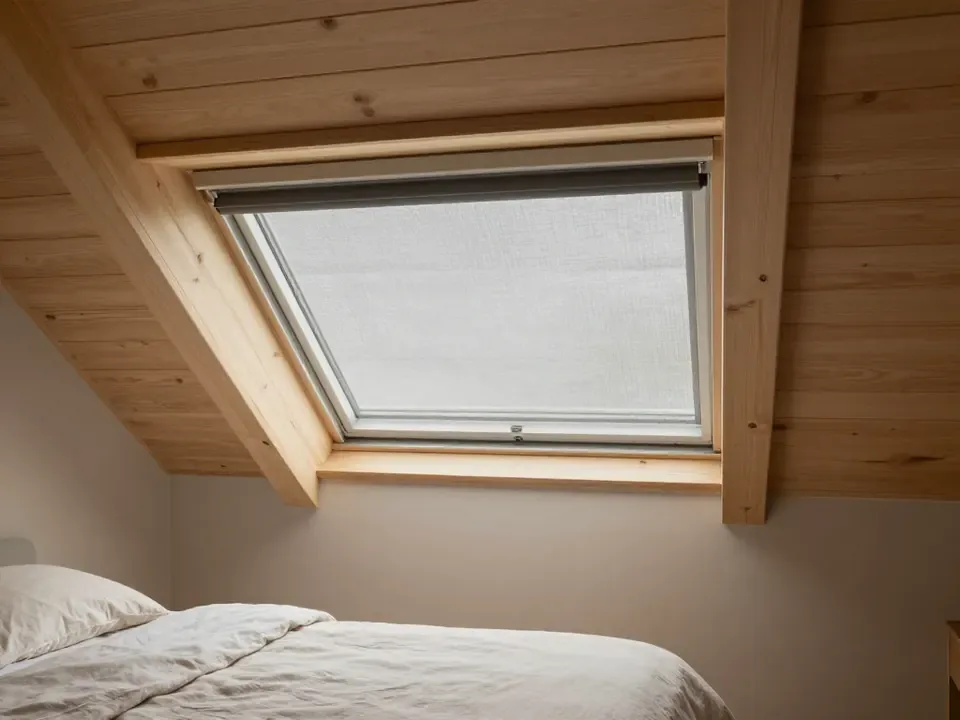
A roof window screen for a sloped frame is usually a framed or pleated model with a mesh and fixing chosen for the task. We make screens to your size, pick the mesh for light, pollen, dust or pets, and select Z-brackets, pins or magnets for your window profile and floor. Measuring is free.
Why a Sloped Window Needs Its Own Roof Window Screen
A sloped frame changes the angle, the direction the sash travels and the way the mesh is held in place. Vertical-window logic does not transfer, and the first signs of trouble appear along the lower edge.
What the Tilt Changes About a Screen
A sloped frame sits at an angle and often opens at the top, so a screen has to hold its mesh against gravity while still letting the sash move. On a roof window the glass leans back, and the movable part usually swings outward from the top or turns sideways for cleaning. That places the weave in a plane no longer parallel to the floor, and its weight pulls toward the lower edge rather than down the side channels. On a tilt-and-turn model the same barrier must survive two different travel paths without interfering with either. On an upright window the side channels carry the load straight down; on a slope the lower rail takes the strain, which is why a thin fixing shows up first as sagging along that edge.
Why a Standard Vertical Screen Falls Short
- Sash swing: a tilt-and-turn casement moves in two directions, so the barrier must clear both positions without contact.
- Load path: on a slope the lower rail carries the weave, not the side channels, so the fixing there takes the strain.
- Fixing depth: a shallow bracket that holds fine upright pulls loose once gravity works down the inclined plane.
- Top corner: the turning casement catches a vertical-style surround here first, where rubbing starts.
- Tension: a slack weave sags along the lower edge before anywhere else, and once it sags it stays slack.
Types of Screens That Work on a Roof Window
Three formats actually cover a sloped opening — framed, pleated and roller. The real difference comes down to how each one folds away and how often you reach for it.
Framed, Pleated or Roller — Which Fits
| Screen type | How it works on a tilt | Best when |
|---|---|---|
| Framed | Lifts out from inside, fixed frame | You open the window rarely |
| Pleated | Folds as the sash moves | The window opens daily |
| Roller | Rolls away into a cassette | You want it out of sight |
Can Any Skylight Take a Screen
We fit screens to plastic, wooden and aluminium windows, including non-standard sizes, because every screen is made to the measured opening rather than cut from a fixed range. The panel is measured on site, so an unusual width or a shallow slope is not a problem in itself. The one thing that decides feasibility is the frame profile, not the window brand — a deep or rounded profile simply needs a different bracket, which the measurer checks on site. When you order a skylight insect screen, the measurer also confirms which mesh and fixing suit the sash, so the screen sits flush instead of rattling against the glass.
Choosing the Right Mesh for Light, Pollen, Dust or Pets
The fabric decides how much sun gets through and what the screen keeps out. We carry five main canvases plus metal and Krylo, and each one answers a different problem in a loft.
Matching the Mesh to the Room
| Fabric | What it does | Good for |
|---|---|---|
| Standard (Fiberglass) | Basic mesh, heat resistant | Everyday lofts |
| UltraVue | 25% extra light and air | Bright attics |
| Anti-Cat (Pet Screen) | Vinyl threads, several times stronger | Homes with a cat |
| Anti-Dust | Finer grid traps dust | Windows facing a road |
| Anti-Pollen (Poll-Tex) | 0.25×1 mm cell | Allergy season |
When Light or a Pet Decides the Choice
- UltraVue: 25% extra brightness and airflow than other fabrics, the pick for a dark attic.
- Anti-Cat (Pet Screen): vinyl threads several times stronger, holding up to the weight of a small animal.
- Anti-Pollen (Poll-Tex): a 0.25×1 mm cell catches fine grains through allergy season.
- Anti-Dust: a tighter grid for windows facing a road or a dusty yard.
- Metal: the toughest canvas we fit, though it cuts sun.
- Krylo: shaped for a sloped pane, cut to the tilt rather than the frame.
How the Screen Attaches to a Sloped Frame
The fixing is what holds the screen against a sloped frame and stops it lifting away from the sash. It is chosen for the window profile and the floor, not picked at random.
Brackets, Pins or Magnets
We fix screens from inside using Z-shaped brackets, pins or magnets, and the measurer chooses which one suits the window profile and floor. Z-brackets hook under the edge and hold a framed screen against the sash without drilling through the profile. Pins, also called plungers, push into small seats on the surround and let you lift the screen off in seconds. Magnets hold a light screen flat with no visible hardware, which suits slim profiles and rooms where the window line matters. Higher floors catch more wind at the open sash, so the fixing is chosen for exposure as much as for the profile — a magnet that is fine low down can be the wrong call on an upper floor.
Matching the Frame Colour to the Window
- Any colour: we paint the screen frame to match your windows rather than working from a fixed palette.
- Inside view: seen from inside against the sky, a mismatched surround is the first thing the eye finds.
- Door profiles: balcony door screens come in Economy 32×10 mm or Prestige 42×17 mm profiles.
- Consistency: a matched surround keeps the window reading as one piece instead of an add-on.
- Sloped angle: on a sloped window the surround sits close to the glass, so colour contrast shows more than on a wall window.
Measuring and Fitting It Yourself or With a Fitter
Some of the work is well within reach of an owner, some is not. The line runs through measurement and fixing choice on a non-standard frame, while seasonal removal and cleaning belong to you.
What You Can Do Yourself
- Remove and refit: a framed screen lifts out from inside in a minute, so pull it down before the cold months.
- Wipe the mesh: a soft brush or a gentle wash clears routine dust without stretching the weave.
- Check the fixings: run a finger along brackets and pins to confirm they still sit tight against the profile.
- Store flat: keep the panel flat rather than rolled through winter, so the surround does not warp.
- Stop at the fixing: moving a bracket or drilling a fresh hole on a tilt is a fitter's job, not a Saturday task.
When the Measurer Should Come
Measuring and consultation are free, and the measurer comes at a convenient time to take sizes and help choose the design, mesh and fixings. A mosquito screen for roof window is exactly the case where a professional visit pays off, because the geometry of a sloped frame leaves little room for error. A sloped window is where self-measurement goes wrong most often: the critical dimension is the clear opening at the movable sash, not the outer surround. The measurer also reads the profile and the floor level, then picks Z-brackets, pins or magnets to match. Order the panel only after that visit — the cost is confirmed in the order once sizes are measured.
Roof window screen — from 25 000 ₸/pcFree measuring and advice, payment after installation. We reply on WhatsApp within 5 minutes.
What to check before ordering for an attic window
A sloped window asks for a screen built around the tilt, not adapted to it. The points below sum up what actually decides whether the screen fits, lasts and stays out of the way.
- Tilt first: a sloped window needs a screen made for the angle, because gravity loads the lower edge and the sash often opens at the top.
- Type by habit: framed, pleated and roller designs each suit a different opening routine, so match the screen to how often the window is used.
- Mesh before colour: the weave decides light and protection, so choose it for the room and only then think about the frame finish.
- Fixing for the frame: brackets, pins or magnets are picked for the window profile and the floor, which keeps the screen from sagging.
- Simple care: routine cleaning takes a minute, but a framed screen lifts out from inside and stores flat through the winter.



