
Mesh types · 8 min read
Anti-dust screen

Senior mosquito screen specialist at moskitnyesetki.kz
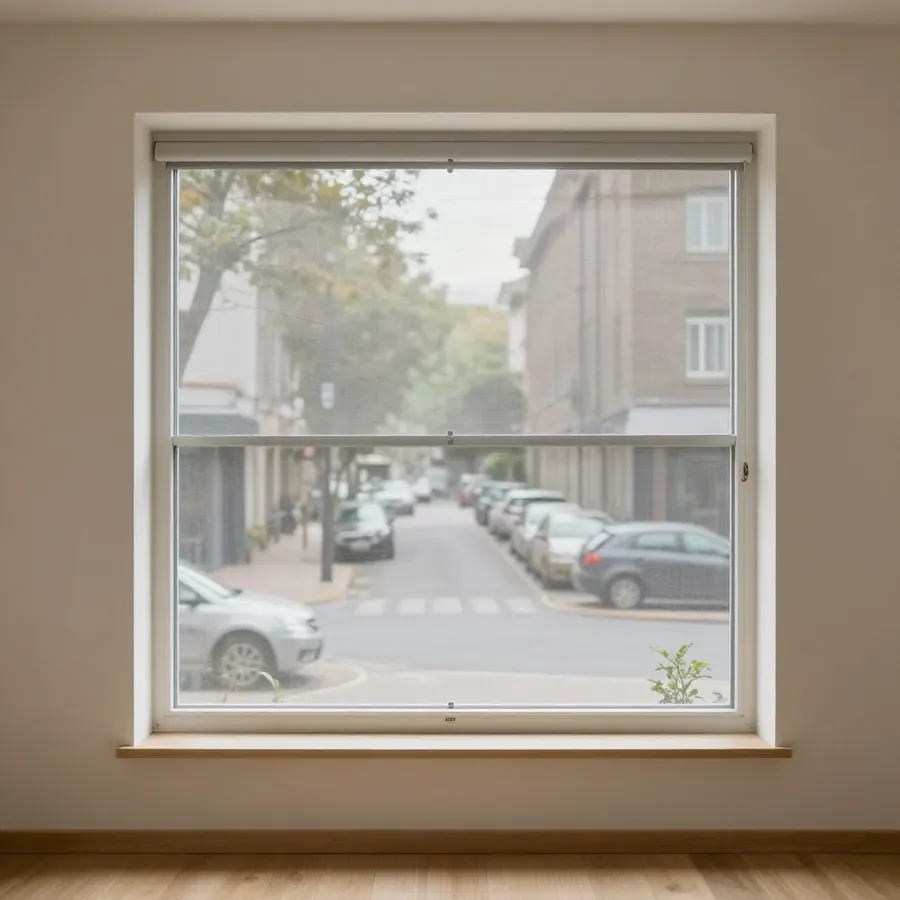
An anti-dust screen helps most on lower floors next to a busy road, where street dust and soot reach windows first. A denser mesh such as Anti-Dust catches more of that dust while still letting air through. The right pick depends on your floor, window profile and how much daylight you want to keep.
Do lower floors by a road really get more dust
Dust and soot lift off the asphalt and settle on the lowest floors first, so a window screen against dust matters more near a busy street than in a quiet courtyard.
Why street dust reaches the first floors first
Road dust is heaviest close to the ground, so the lowest floors collect the bulk of it before it disperses higher up. A second-floor flat above a busy street sits in that band: exhaust soot, tyre particles and mineral grit drift up a few metres and drop onto sills, frames and glass. The black film on a windowsill near traffic is mostly fine carbon and rubber, not household fluff. A standard fiberglass cloth lets this fraction straight through, while a denser Anti-Dust sheet holds it at the surface. Higher floors get a thinner share as the plume dilutes with height. If the sill turns grey within a week, the load is high and a denser weave is the first thing to try.
Is it worth it on every window or only the road-facing ones
- Traffic side first: these openings take the most soot and grit.
- Quiet side later: inner ones can stay on a standard mesh if dust is mild.
- One test screen: fit a single unit and watch the sill for a few weeks.
- Mixed meshes: a flat can combine Anti-Dust at the front with Ultravue elsewhere.
- Measurer's input: our fitter checks the profile and floor before you commit.
- Low-risk start: one road-facing screen changes how often you wipe the sill, so you can test the effect before covering the whole flat.
How an anti-dust screen works with air and light
A denser weave traps more dust but affects light and airflow, so the real question is where a sensible balance sits and how to keep the room comfortable without darkening it.
Does a denser mesh block airflow and daylight
A denser weave does cut some airflow and light, but the difference is smaller than most people expect and depends on the cloth. A standard insect screen leaves cells wide enough that air passes almost freely, while a fine dust weave adds resistance at every opening. The drop is noticeable on a still day, not on a breezy one. Light behaves differently: a dark or thick thread absorbs more of it, so the interior reads dimmer even when the open area is similar. Ultravue, a high-transparency cloth, lets in 25% more light and air than other options, suiting windows that already face a shaded street. If daylight matters more than maximum filtration, a high-transparency option keeps the interior brighter while still catching coarse dust.
Standard fiberglass versus a dust screen for windows
- Standard fiberglass: the everyday grey cloth keeps insects out and lets most road grit pass straight through.
- Tighter weave: a denser cloth catches a larger share of fine particles, so less settles on the sill.
- Cell size: the finer the opening, the more dust it holds, and the sooner the surface loads up.
- Airflow: both pass air, but the tighter weave feels softer on a still day.
- Upkeep: a loaded fine mesh needs rinsing more often, otherwise airflow drops.
- Frame options: our Anti-Dust canvas comes in a painted frame matched to your window colour.
- Durability: standard fiberglass resists ignition and temperature swings on a sun-facing facade.
Which anti-dust screen to choose for a dusty flat
Near a road, street dust and pollen often act at once, and each mesh is built for a different job. Here is how the options differ and how to pick one.
Anti-Dust versus Anti-Pollen when you also have allergies
Anti-Dust versus Anti-Pollen when you also have allergies Anti-Dust targets street dust, while Anti-Pollen (Poll-Tex) with its 0.25×1 mm cell catches fine pollen, so the pick depends on which bothers you more. A window screen traps heavier grit from the roadway, whereas Poll-Tex cloth holds much smaller pollen grains that drift in during flowering season. If your eyes and nose react every spring, the pollen cloth usually helps best; if the sill turns grey within a week, the dust version earns its place. Near a road both loads can overlap, so tell the measurer which symptom is worse before choosing one mesh for the whole flat.
Matching the mesh to your situation
| Mesh | Best for | What it does |
|---|---|---|
| Anti-Dust | Flats near a road | Catches more street dust |
| Ultravue | Keeping daylight | 25% more light and air |
| Anti-Pollen (Poll-Tex) | Allergy to pollen | 0.25×1 mm cell for fine pollen |
| Anti-Cat (Pet Screen) | Homes with pets | Stronger vinyl threads |
| Standard (Fiberglass) | Insects only | Basic, heat-resistant weave |
What you can fit yourself and when to call a measurer
Some of this work is genuinely doable on your own, though the window type and the floor change which fixing you need. Here is where the line sits.
Can you install a dust screen on a plastic window yourself
A ready-made framed screen can be fitted yourself on most plastic units, but a made-to-size model needs correct measurements first. A framed version lifts onto the sash and holds by its own brackets, so nothing beyond a screwdriver is involved. A pleated or custom unit is a different job: the surround must match the opening to the millimetre, and a gap of a few millimetres lets in exactly the dust the mesh is meant to stop. Measuring is free with us, and the measurer takes sizes and helps choose the mesh and fixings on site. The tricky part is matching the hardware to the sash, where a wrong guess shows up as a loose or rattling screen.
Why the floor and window profile decide the fastening
- Z-brackets: a firm hold for most plastic frames and exposed upper levels.
- Pins (plungers): quick to fit and easy to remove on standard sashes.
- Magnets: a neat option where drilling into the frame is not wanted.
- Height check: higher up catches more wind, so the hold may need to be firmer.
- Frame check: the measurer matches the hardware to your unit before ordering.
Cleaning, winter removal and keeping the screen effective
An anti-dust screen in the city clogs faster than a standard sheet, so upkeep decides how well it keeps working. Below we cover cleaning, winter removal and when a screen alone is not enough.
How often to clean a dust screen in a city
In a dusty city a dust screen usually needs cleaning more often than a standard sheet, because the tighter weave traps more particles. Where a fiberglass panel might get a rinse two or three times a season, an Anti-Dust fabric on a road-facing casement wants attention every few weeks — a soft brush, then a shower rinse from the room side. Never scrub it with a hard brush or a pressure washer: the fine threads stretch, and the gaps open up exactly where they were meant to hold dust back. A clogged mesh quietly cuts airflow, so a stuffy room points to the screen rather than the opening itself.
Should you take the screen off for winter
A framed screen comes off from inside in a minute, and we suggest removing it for winter when dust and insects are less of an issue. We make and fit these panels in our own workshop, so the frame, the fabric and the fastenings all match your profile. Taking it down also gives you a chance to wash and store it flat, so it goes back on in spring without bent corners or a clogged surface. A screen only filters air passing through it, though, so a stuffy flat in the cold months usually points to weak ventilation rather than the mesh.
"Anti-Dust" screen — from 12 000 ₸/m²Free measuring and advice, payment after installation. We make a frame screen in 10–15 minutes.
When dust protection on the lower floors pays off
- Start with road-facing windows: lower floors near traffic collect the most street grit, so the densest weave pays off first.
- Accept a small trade-off: a dust screen trims some light and airflow; high-transparency mesh is the balance point.
- Match the mesh to the problem: Anti-Dust handles fine street particles, while Anti-Pollen suits pollen troubles more.
- Check the fixing before you buy: a framed screen goes in yourself, but floor and window profile decide the bracket.
- Keep it breathing: clean the weave more often in a dusty city, and lift a framed screen out for winter.



