
Choosing · 8 min read
Balcony door screen

Senior mosquito screen specialist at moskitnyesetki.kz
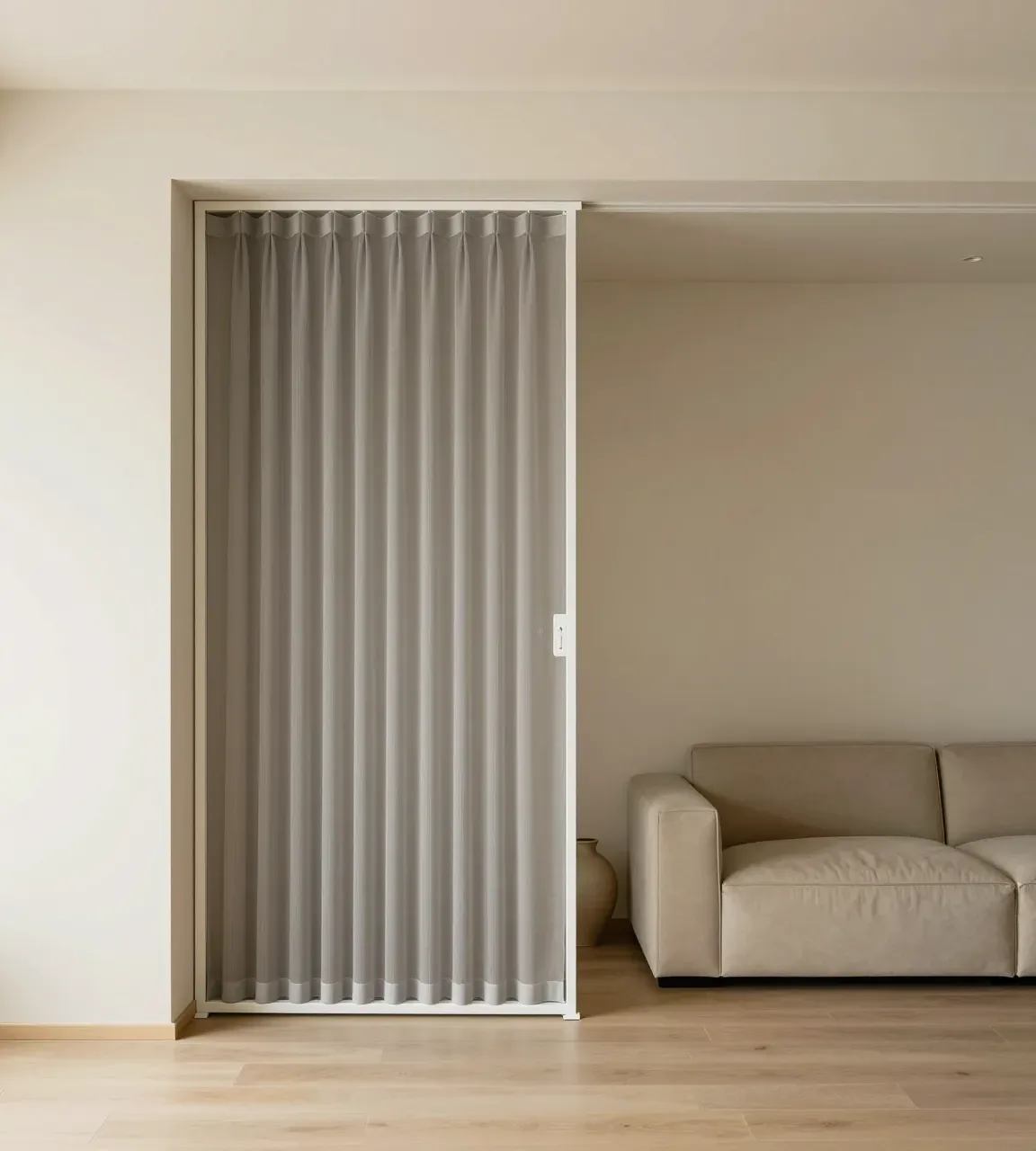
A balcony door screen from us comes in two types: a pleated (accordion) door that folds along guide rails, and a hinged (frame) door that swings on hinges. The right pick depends on your opening width, swing space, door direction and mesh needs. We make both to measure in our own workshop and install them ourselves.
How a Pleated and a Hinged Screen Door Actually Work
Both are balcony door screens, but mechanics differ: a pleated one folds into an accordion along guide rails, while a hinged one is a rigid frame on hinges.
How the pleated accordion mechanism works
A pleated screen door folds into an accordion along guide rails, so it needs no swing space and slides out of the way in one movement. The folded mesh runs top and bottom inside aluminium tracks, and the panels stack tight against one jamb when you pull the handle. Nothing protrudes into the room or swings toward the opening, which matters on a narrow landing where a frame would catch on the wall. We make pleated screens in our own workshop, and a made-to-size unit takes 40 to 60 minutes to assemble. The folds are the wear point — keep the rails clean and free of grit and the mechanism stays smooth far longer.
How a hinged frame door opens and closes
A screen door of this type is a rigid frame on hinges that swings open like a normal door and closes against a magnetic latch. The frame carries the mesh under tension, so it holds a flat surface instead of folds, and the magnetic closure pulls it shut on the last few centimetres without a handle turn. Such door screens come with Economy 32×10 mm or Prestige 42×17 mm profiles, and we paint the frame any colour to match your windows. Because the whole frame swings, the side it opens toward must stay clear — check that before choosing, not after the frame is made.
Choosing a Balcony Door Screen by Opening Width and Swing Space
The deciding factor is rarely taste — it is the aperture and the direction the leaf moves. Check whether a swinging panel has room and will block the path.
Narrow openings and outward-opening doors
For a narrow gap or an outward-opening door, a pleated model is usually the safer fit because it folds flat instead of swinging into the room. The pleated leaf gathers into a slim stack at one edge, so a leaf that opens outward never fights the mesh for the same air. A hinged screen door, by contrast, is a solid frame on hinges and needs free space on its swing side to open at all. We build both types in our own workshop, and the folding version is the one we make for tight apertures and outward-opening leaves. Measure the bare wall beside the door, not just the gap — a hinged panel with nowhere to swing is the most common reason a made-to-measure door has to be remade.
Swing space, thresholds and carrying things through
- Swing clearance: check floor and wall where the hinged leaf opens, keeping that arc free.
- Threshold height: a raised sill means the swinging frame must clear it; measure sill height first.
- Walkway width: a folding door slides along the edge, keeping the passage open on narrow balconies.
- Hands full: carrying boxes through a door that swings toward you becomes a juggling act.
- Everyday traffic: count daily use — a busy balcony favours the type that never blocks the route.
Light, Air and the Right Mesh for a Balcony Door Screen
The door type sets the mechanics; the fabric sets how much light and air get through and what the screen holds back. Here is how each mesh matches each door.
Which mesh lets in the most light and air
UltraVue mesh lets in 25% more light and air than other meshes, and it works equally well in a pleated or a hinged frame. On a door facing away from the sun, the room stays brighter at midday, and airflow feels less blocked when the door is open. Standard Fiberglass, our everyday weave, is denser and noticeably dims a shaded room, though it resists ignition and temperature swings without complaint. In our practice, people who complain about a dark room almost always have a standard mesh fitted. On a shaded side the mesh matters more than the door type, so pick the fabric for the light you actually get, not for the mechanism you like.
Matching the mesh to dust, pollen and everyday use
| Mesh | Best for | What it does |
|---|---|---|
| Standard (Fiberglass) | everyday use | resists ignition and temperature swings |
| UltraVue | light-starved balconies | 25% more light and air than other meshes |
| Anti-Dust | dusty balconies | traps fine dust before it reaches the room |
| Anti-Pollen (Poll-Tex) | allergy season | 0.25×1 mm cell catches pollen |
| Anti-Cat (Pet Screen) | homes with pets | vinyl threads hold a small pet's weight |
Cats, Pets and Stronger Meshes
If a cat shares your flat, whether the mesh survives claws matters more than the folding mechanism, and a pet shifts the door choice.
Will the screen stop my cat from getting out
- Anti-Cat (Pet Screen): vinyl threads are several times stronger than standard mesh and hold a small pet's weight, so claws do not tear through.
- Standard (Fiberglass): fine for insects and everyday wear, but a determined cat can work a hole over time.
- Frame and fastenings: cats push at edges, so we match Z-brackets, pins or magnets to your window profile and floor.
- Tension: a taut canvas spreads a paw's load; a loose one gives claws grip.
- Height of the opening: a low sill lets a cat push at the base, so the bottom rail needs a firm seat.
Does a cat change the choice of a pleated or hinged screen door
A cat does not decide the door type, but a hinged frame with a firm magnetic latch resists a pet pushing at the closed door better than a folding one. Anti-Cat (Pet Screen) works in both designs, so the fabric is settled first and the mechanism follows. A hinged screen swings on its hinges and shuts with a magnetic latch, holding the leaf flat against the frame when a cat leans on it. A pleated screen folds into a compact stack, and the folds are what a pet tests most. Watch your cat: one that slips through gaps probes pleated edges, while one that leans and pushes suits a rigid hinged frame with Anti-Cat.
Wind, Cleaning and Winter Care
A balcony door faces draughts, gusts and dust. Here is how each type behaves in wind and how to care for the mechanism to last for years.
Stopping the door from slamming in the wind
Stopping the door from slamming in the wind A hinged screen door closes against a magnetic latch that holds it shut in a draught, while a pleated door stays put in its guide rails and does not swing at all. On a hinged frame a gust catches the fabric like a sail and pushes it back and forth until the magnet grabs. A pleated model has no swinging leaf: the folded fabric slides in its tracks and only moves when you pull the handle. We fit hinged doors with either the Economy 32×10 mm or the Prestige 42×17 mm profile, and the measurer picks the fasteners. On an exposed balcony check the magnet engages cleanly over its full length, because a half-caught latch lets a door rattle.
Cleaning the folds and taking the screen off for winter
- Brush the pleats: brush folded fabric monthly so dust does not settle in creases.
- Wipe the tracks: clear rails with a damp cloth, since grit grinds the fabric.
- Lift framed screens out: a framed door screen comes off from inside and stores flat.
- Leave pleated screens in place: the accordion stays on its rails through winter and needs only an occasional brush-out.
- Rinse, then dry fully: wash the fabric with water and air dry before closing, so damp material does not sit folded.
Pleated screen — from 25 000 ₸/pcFree measuring and advice, payment after installation. We make a pleated screen in 40–60 minutes.
What decides the choice for a balcony door
The decision comes down to how the door opens, how much room the balcony has and what the mesh has to withstand day to day.
- Pleated door: folds along guide rails, needs no swing space, suits narrow or outward-opening balcony doors.
- Hinged door: swings on hinges, closes with a magnetic latch, needs clear floor and room over a high threshold.
- Mesh choice: UltraVue adds light, Anti-Dust and Anti-Pollen handle dust and pollen, Anti-Cat resists pets.
- Windy balconies: latch and fastenings keep the door steady; match them to window profile and floor.
- Upkeep: clean folds and rails regularly, lift a framed screen out for winter to keep the mechanism smooth.
Source: Neher's page on pleated screens.



