
Mesh types · 8 min read
UltraVue screen

Senior mosquito screen specialist at moskitnyesetki.kz
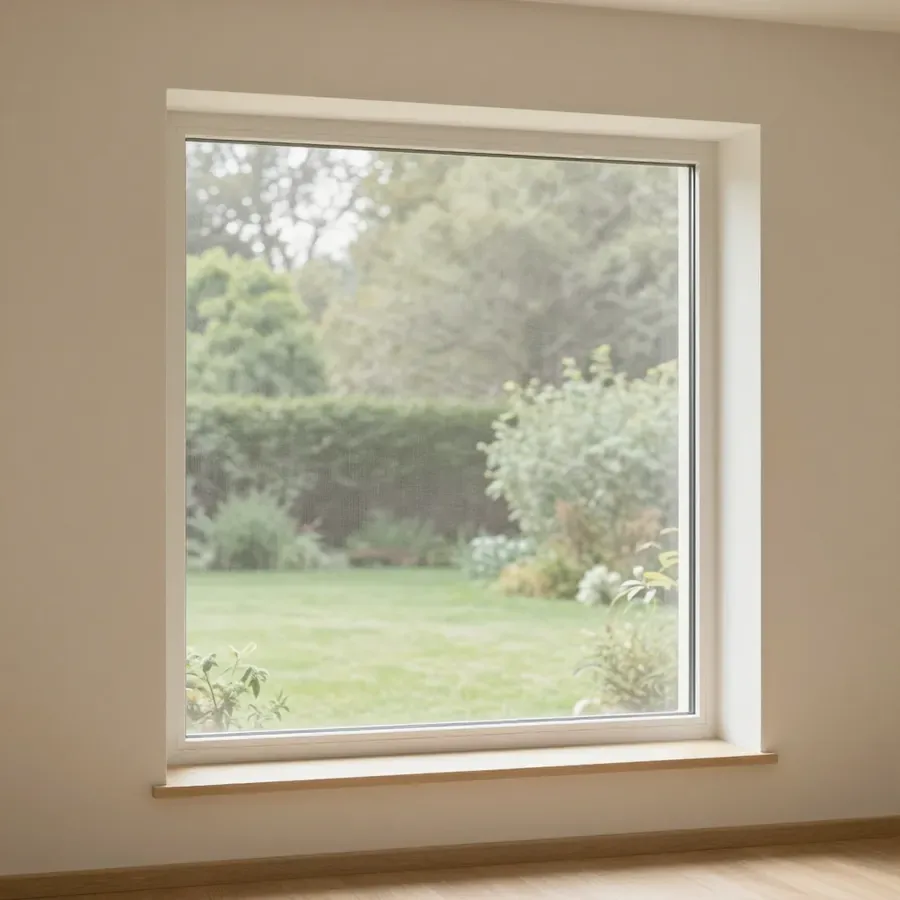
The UltraVue screen is a fine-mesh fabric that reads as almost invisible because its thread is thinner and its weave tighter than standard fiberglass, and it lets in 25% more light and air. You still notice it against bright backlight, but in everyday daylight it largely disappears from view.
What Almost Invisible Really Means
"Almost invisible" describes physics, not magic: thinner thread, tighter weave, darker tone. Here is what actually makes a fabric fade from view, and where the limit sits.
Why a thinner thread and tighter weave read as invisible
- Thread diameter: a thinner monofilament casts a narrower shadow, so each strand reads as a faint line rather than a dark bar.
- Cell size: smaller openings pack strands closer together, and the eye blends them into a soft haze.
- Open area: the ratio of holes to material decides how much light and air pass through.
- Tone: a dark strand absorbs light and recedes against a bright window, while a pale one outlines itself.
- The Ultravue difference: finer monofilament and a less obtrusive cell than Standard fiberglass, so the grid dissolves sooner.
When you still see the mesh
Any mesh becomes visible against strong backlight — at dusk with a lamp on inside, or when the sun sits directly behind the window. The eye adapts to the darker interior and the panel turns into a fine silhouette; in flat daylight the same sheet all but disappears. Viewing angle matters above all: from an oblique angle the strands overlap visually and the grid thickens, while a straight-on look keeps it thin. A clear view window screen on a south-facing opening shows itself at low sun far sooner than the same sheet on a shaded side. Judge a sample straight-on in normal daylight, not at sunset, and check it from the sofa and the doorway before deciding.
UltraVue Screen Against Standard Fiberglass
The usual question is whether the difference is real or marketing. Here is what changes in a room when you swap a standard fiberglass mesh for Ultravue.
What 25% more light and air feels like in a room
We fit the ultravue screen knowing it passes 25% more light and air than other meshes, and in a south-facing room that reads as a brighter, less stuffy space on a still day. The gain shows up where airflow is limited by a single opening: a kitchen window above a sink, a bedroom with one sash, a glazed loggia that traps heat by mid-afternoon. On a wide living-room window the finer weave lets more daylight reach the floor and keeps the outside view readable instead of hazy. The effect is optical as much as physical, since a thinner thread scatters less light before it enters the glass. The gain is most noticeable on large windows and in rooms with one opening; on a small vent window the difference is real but easy to miss, so match the fabric to the window you actually live behind.
Side-by-side differences that matter
| Parameter | Ultravue | Standard (Fiberglass) |
|---|---|---|
| Thread | Thinner, finer weave | Standard thickness |
| Visibility | Almost invisible in daylight | Noticeably visible grid |
| Light and air | 25% more than other meshes | Baseline |
| Best for | Bright rooms, clear views | General use, budget builds |
Choosing the Right Fabric for Your Home
An invisible mosquito screen is not always the right answer. A cat, a pollen allergy or a dusty street each push the choice toward a different fabric.
Cats, pollen and dust decide the fabric
We steer cat owners to Anti-Cat (Pet Screen), whose vinyl threads are several times stronger than ordinary mesh, and allergy sufferers to Anti-Pollen (Poll-Tex) with its 0.25×1 mm cell. Households facing a dusty street do better with Anti-Dust, where the denser weave holds fine particles back before they settle on the sill. Ultravue stays the pick when daylight and airflow matter more than filtration, since it lets in 25% more light and air than other meshes. In our workshop we cut all of these from the same frame stock, so the fabric, not the profile, is what changes the result.
Matching fabric to the job
| Household need | Recommended fabric | Why |
|---|---|---|
| Maximum light and clear view | Ultravue | 25% more light and air |
| Cat in the home | Anti-Cat (Pet Screen) | Vinyl threads resist claws |
| Pollen allergy | Anti-Pollen (Poll-Tex) | 0.25×1 mm cell traps fine grains |
| Dusty street | Anti-Dust | Denser weave holds dust back |
| General use | Standard (Fiberglass) | Reliable and heat-resistant |
Fitting an UltraVue Screen to Your Windows
Ultravue fits the same frames as any other mesh, but the frame profile and the fixing decide how clean the result looks and how well it holds.
Which windows and doors take the fabric
We fit the fabric on plastic, wooden and aluminium units, vent panes, loggia glazing, and on door, gazebo and veranda screens, so it is rarely limited by what you already have. Our own workshop cuts and frames the panel to your measured size and paints it any colour to match the joinery, and the measurer confirms the opening is square before the panel is made. A hinged entry screen carries the heavier load of daily opening, while a fixed balcony unit mostly resists wind and sun. The real constraint is the frame, not the glass — an old wooden rebate that has warped may need a different fixing before any panel sits flat. Check the rebate depth and that the opening is square before you order a made-to-size panel; an out-of-square opening is what later shows up as a sagging or rattling screen.
Profiles and fixings that hold the frame
Hinged door screens come with an Economy 32×10 mm or Prestige 42×17 mm profile, and our measurer picks Z-brackets, plunger pins or magnets to suit the window and the floor. The narrower Economy keeps a slim line on a standard balcony leaf, while the deeper Prestige carries a wider mesh with less flex on a busy entrance. Plunger pins let you lift a window screen out in seconds, magnets hold a light panel flush on a smooth surface, and Z-brackets clamp the edge where the opening gives little room. On a tall leaf the fixing carries more of the panel weight, so the measurer checks the frame depth before choosing between pins and brackets.
Care, Winter Storage and Repairs
A fine mesh stays discreet only while it is clean and intact. A few habits keep it that way, and a torn sheet is usually a repair, not a replacement.
Cleaning and winter habits that keep it clear
We advise a soft vacuum head on low suction rather than a wet scrub, and a framed screen lifts out from inside in a minute, so taking it down for winter is a quick job. A dry pass removes most dust from the weave; a damp cloth pressed too hard pushes lint into the threads and dulls the surface. For deeper grime, rinse the fabric flat and let it dry fully before refitting, since wet material stretched back into the housing can sag. Dust settles into a fine weave faster than a coarse one, so an invisible screen rewards regular light cleaning more than a standard mesh does.
Repair or replace a damaged panel
We repair screens and replace fixings, and a small tear is usually a cloth swap rather than a whole new build, which keeps the profile and the fit you already have. A corner split, a pulled-out spline or a hole from a branch rarely damages the aluminium profile, so the workshop cuts a fresh sheet and sets it into your existing housing. Heavier damage — a bent surround or a broken hinge on a door unit — is a different job and gets new parts. A tear at the edge often signals a worn fixing pulling the fabric, so replace the mounting at the same time or the replacement will fail the same way.
"UltraVue" screen — from 7 900 ₸/m²Free measuring and advice, payment after installation. We make a frame screen in 10–15 minutes.
What a nearly invisible mesh really gives you
A clear screen always balances visibility against strength, and the right fabric depends on what your window has to cope with.
- Clarity comes from the weave: the mesh reads as almost invisible thanks to thin threads and a tight weave, not any special coating.
- Backlight reveals it: expect to notice the grid against strong backlight at dusk or when the sun sits behind the glass.
- Light and air differ: a high-visibility fabric passes noticeably more daylight and airflow, which shows most on large openings.
- The job picks the material: a cat, a pollen allergy or a dusty street each point to a different option than the clearest one.
- Habits extend the life: routine gentle cleaning and winter removal keep a delicate mesh discreet and intact far longer.
Source: Phifer's screening FAQ on visibility.



